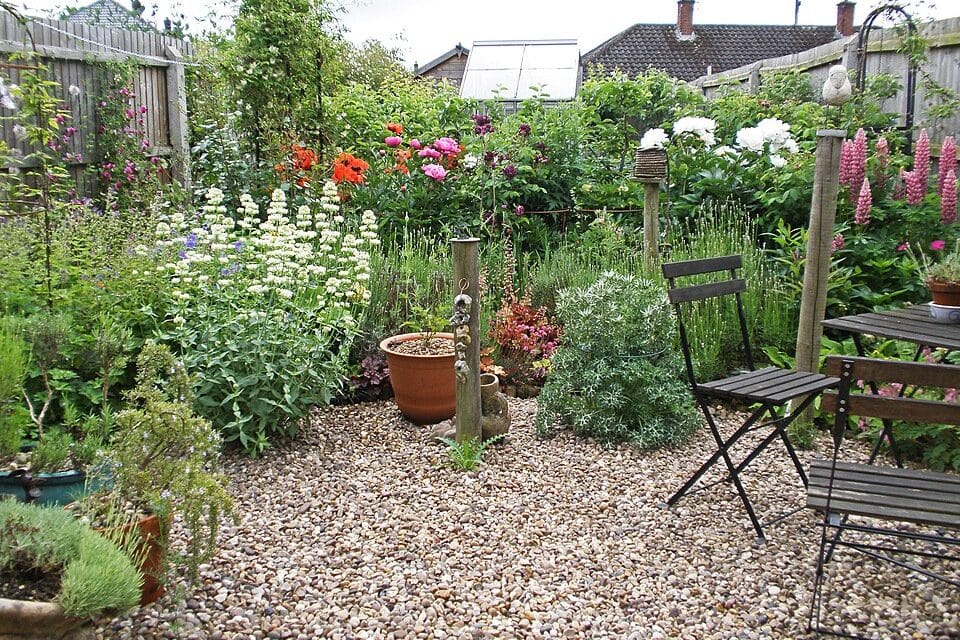
Stand in most English gardens by mid-July and you can point to the border that is losing the argument with the weather. The hostas have gone crisp at the edges, the astilbe has folded flat against the soil, and someone is out there every evening with a watering can, running a losing race against evaporation. The frustrating part is that this isn’t really a watering problem. It’s a planting problem — a border stocked with woodland and bog-loving species trying to survive on a free-draining bank in full sun, propped up by a hose that increasingly isn’t allowed to run.
Rebuilding that border for drought doesn’t mean gravel and three sad grasses. Done properly, a Mediterranean-leaning scheme is one of the more visually generous styles available to a UK gardener — silver foliage, long flowering windows, texture that holds through winter instead of collapsing into black mush. It just asks you to stop fighting your own soil and instead work out what your particular patch actually wants to grow.
Read the site before you buy a single plant
Drought-tolerant planting fails most often not because the plant list was wrong, but because someone bought a 'gravel garden' plant list written for Beth Chatto’s Essex shingle and planted it into heavy Midlands clay that sits wet all winter. Mediterranean plants such as lavender, rosemary and cistus are drought-tolerant in summer precisely because their native soils drain fast; put the same plant into clay that holds water from November to March and you’ll lose it to root rot before it ever gets the chance to prove itself in a dry spell. Dig a hole 30cm deep, fill it with water, and time how long it takes to drain. Anything slower than an hour needs serious grit and horticultural sand worked through the top 40cm, or raised beds, before you plant anything Mediterranean.
Aspect matters just as much. A south-facing bank against a brick wall runs several degrees hotter than open ground — that’s exactly where rosemary and Jerusalem sage will be happiest, and exactly where a rhododendron was always going to sulk. If your border faces north or sits under the shade of a mature tree for half the day, don’t force the gravel-garden look; look instead at drought-tolerant shade plants like Euphorbia amygdaloides var. robbiae or Geranium macrorrhizum, which tolerate dry shade far better than anything silver-leaved ever will.
The plant list that earns its keep
Start with the structural backbone rather than the flowers — it’s the woody and evergreen framework that carries a drought border through the parts of the year when nothing is blooming. Rosemary (Salvia rosmarinus, still sold as Rosmarinus by most nurseries) gives year-round structure for under £8 a pot at most garden centres and, once established after its first summer, needs no supplemental water at all. Lavender — 'Hidcote' for tight, dark-purple hedging or 'Munstead' if you want something slightly hardier through a wet winter — sits around £6–£10 per plant and pays that back within two seasons once it bulks out. Cistus (rock rose) is criminally underused in UK gardens: white or pink flowers all June, silver-grey foliage the rest of the year, and it will take poor stony ground that kills almost everything else, for roughly £12–£15 a specimen.
For height and movement, ornamental grasses do more work per pound than almost anything else on this list. Stipa tenuissima (Mexican feather grass) moves in the lightest breeze and self-seeds gently rather than aggressively, at around £7 a pot. Miscanthus sinensis varieties give you a taller, more architectural presence from midsummer through to when you cut them back in late February — expect to pay £10–£18 depending on cultivar and pot size. Sedum (now technically Hylotelephium, though nobody at the garden centre will correct you for using the old name) closes the season out, flowering into autumn and standing through frost as seedheads that catch every low winter sun.
What to leave out, whatever the catalogue promises
Hydrangeas, astilbes, hostas and most ferns are marketed constantly as 'low-maintenance' border plants, and every one of them is thirsty enough to need hand-watering through any dry fortnight. Skip them here — put them in the shadiest, dampest corner of the garden instead, where they’ll actually thrive without intervention. The same goes for bedding lobelia and busy lizzies, which are bred for constant irrigation and will simply die back the first week you can’t get out with a can.
Soil preparation is the part people skip
The temptation with a drought border is to treat the planting as the whole job and skimp on preparation, since these are supposedly tough plants that don’t need pampering. That’s backwards. Every Mediterranean and prairie-origin plant needs excellent drainage to survive a wet British winter — it’s winter waterlogging, not summer drought, that actually kills most of these species in UK gardens. Before planting, strip back turf or existing weak growth, then dig in horticultural grit at a rate of roughly one 25-litre bag per square metre for anything heavier than a sandy loam. On genuinely heavy clay, go further and build a raised bed or mound the border 15–20cm above the surrounding grade so excess winter rain has somewhere to run rather than pooling around the crowns.
Mulch matters here in the opposite way it does in a woodland border. Skip bark chip and composted manure, which hold moisture against the stems and encourage the rot these plants are trying to avoid. Use a 5cm layer of horticultural gravel or slate chippings instead — it reflects heat back up into the plant, suppresses weeds without smothering, and keeps the crown of the plant dry even in a wet spell. A bulk bag of decorative gravel covering roughly 10 square metres runs £45–£70 depending on the stone and how far it has to travel, which is not a trivial outlay, but it’s a one-off cost against years of not running a hose.
When to plant, and how to get establishment right
Autumn is the better planting window for drought-tolerant schemes, even though every garden centre stocks these plants hardest in May. Planting in September or October gives roots the whole autumn and winter to establish into cooler, more reliably moist soil before they face their first proper test the following summer — a plant put in during a June heatwave has to cope with drought stress in its first weeks, which is exactly the scenario you’re trying to design around. If autumn planting isn’t practical, spring planting works too, but commit to watering weekly through the first summer regardless of what the label promises. Nothing is drought-tolerant until its roots have had a full season to get down past the top 10cm of soil, and treating a new plant as self-sufficient from day one is the single most common way people fail with this style.
Water deeply and infrequently during that establishment year rather than little and often — a slow soak once a week that reaches 20–30cm down encourages roots to chase the moisture deeper, while a daily five-minute sprinkle keeps roots lazy and shallow, right where they’ll cook the moment you stop. After twelve months in the ground, most of the plants on this list should need no irrigation at all beyond genuinely exceptional dry spells, which is the entire point of doing the redesign in the first place.
What this actually costs, and what it saves
For a medium border of around 12 square metres — a reasonable size for a semi-detached front garden or a side return — budget somewhere between £250 and £400 for a mixed planting scheme of the plants above, plus £60–£90 for gravel mulch and £20–£40 for grit if your soil needs amending. That’s not a cheap afternoon at the garden centre, and it’s fair to flag that a gravel garden looks sparse for its first year while everything establishes; it doesn’t fill in and photograph well until year two. But set against a summer of a rota watering ban, a dying lawn, and replacing perennials that cooked in the June heat for the third year running, it’s a redesign that pays for itself faster than most garden projects. And it’s one of the few changes you can make now, this planting season, that will still be doing its job with almost no input from you in five years’ time.
The upkeep changes shape rather than disappearing
Nobody selling you a drought-tolerant border will mention that it swaps one kind of maintenance for another rather than eliminating maintenance altogether. Lavender and cistus both need a firm trim after flowering — cut lavender back hard into old wood and it will sulk for a year or die outright, so trim into the current season's soft growth only, taking off about a third of the plant each August. Grasses want cutting back to a few centimetres above the crown in late February, before new growth starts, and skipping that job for even one year leaves a tangle of dead blades that new shoots have to push through. None of this is difficult work, but it happens on a different calendar to deadheading bedding plants, and a border left entirely alone for two or three years will still get straggly, even if it never once needs a hose.
Rabbits and deer, if either is a problem in your garden, actually make this style easier rather than harder. Lavender, rosemary, cistus and most ornamental grasses are aromatic or tough-leaved enough that browsing animals leave them alone, which is more than can be said for hostas or tulips. The one plant on this list worth watching is Stipa tenuissima, which self-seeds freely enough in a warm, sheltered spot that you'll want to shear off the seed heads before they drop if you don't want feather grass turning up in the gravel path two years from now. Buy from a local grower where you can — West Country Lavender and specialist nurseries advertised through the RHS Plant Finder tend to sell better-rooted stock than the trays stacked outside supermarkets in May, and the difference shows in how fast the plants establish.