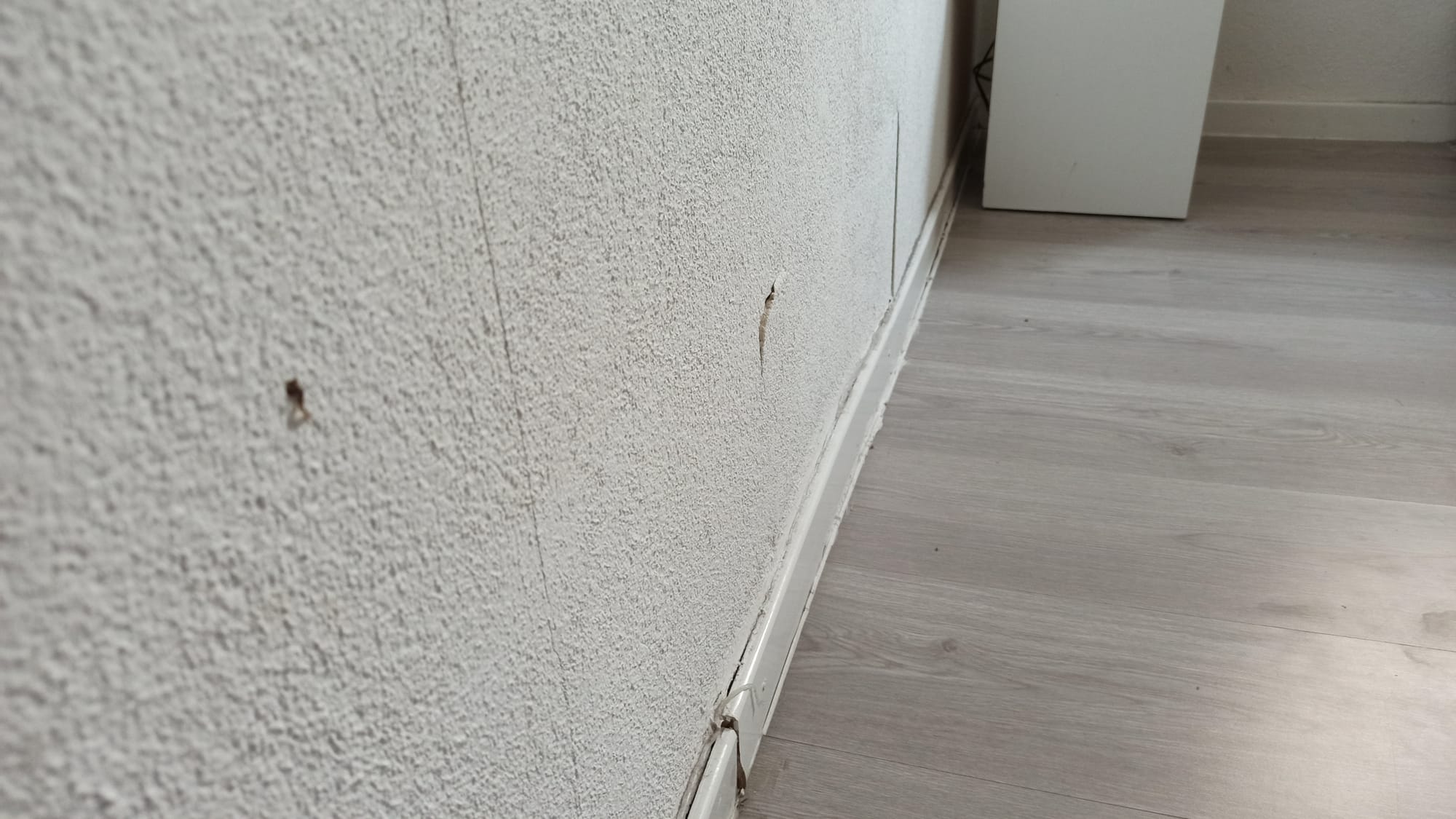
You spot it on a Sunday afternoon, doing nothing more taxing than deadheading roses near the front wall — a thin diagonal line running up from the corner of the lounge window, wider at the top than it is at the bottom, and definitely not there in May. After six weeks with barely ten millimetres of rain and daytime temperatures sitting in the high twenties, a lot of southern England is looking at cracks like this one right now, and the instinct is to assume the worst. Subsidence has a fearsome reputation among UK homeowners, tangled up with stories of five-figure underpinning bills and houses that won't sell. Most of what's appearing on walls this summer isn't that. But some of it is, and the only way to tell the difference is to look properly rather than guess.
Why a dry summer turns clay subsoil into a moving target
Southern and eastern England sit on some of the most shrinkable clay in the country — London Clay under much of Essex, Kent and the Thames Valley, gault clay further out towards Cambridgeshire — and clay behaves almost like a sponge running in reverse during a drought. As the moisture drains out of the top metre or so of soil, the clay particles pull tighter together and the ground genuinely shrinks, sometimes by several centimetres over a dry summer. A house built on shallow Victorian or Edwardian foundations, typically no more than half a metre deep, sits directly on that shrinking layer with nothing to isolate it from the movement. Newer homes built after the 1970s usually have deeper foundations, often a metre or more, which is one reason subsidence claims skew so heavily towards older housing stock. Add mature trees into the mix — oak, willow, poplar and cherry are the classic offenders because their root systems can extend further than the tree is tall — and the drying effect concentrates exactly where a house's foundations happen to sit. The Association of British Insurers has tracked subsidence claims for decades, and the pattern is consistent: 2003, 2018 and 2022 were all drought years, and all three produced spikes in subsidence notifications running into the tens of thousands nationally.
Reading the crack: is this subsidence, or is it just the plaster moving?
Not every crack that opens up in a heatwave is telling you the same story, and the difference between a genuine subsidence crack and everyday seasonal movement usually comes down to four things: width, direction, what it passes through, and shape.
A crack that's worth taking seriously tends to share most of these traits:
- It runs diagonally, often at roughly 45 degrees, from the corner of a door or window opening — those corners concentrate stress because they're the weakest point in a wall.
- Wider at one end than the other, tapering along its length rather than staying a uniform width
- Passing straight through brick and mortar rather than stopping at a joint, and visible on both the inside and outside of the wall
- More than about 3mm across — anything narrower is generally cosmetic movement rather than structural, though a structural engineer is still the one who gets to make that call, not a rule of thumb
Plaster cracks, by contrast, are shallow, hairline, and don't continue through to the brickwork outside. They often follow old repair lines or run along ceiling joints where two different materials meet, they stay the same width from one end to the other, and they show up every summer without ever seeming to get worse. A lot of what people notice in a dry spell falls into exactly this category — annoying, worth a tube of filler, not worth a phone call to a structural engineer.
What to do the moment you spot a suspect crack
Photograph it before you do anything else.
Take a clear photo with a ruler or coin next to the crack for scale, note the date, and repeat the process in two to four weeks. Movement that's stable — the crack looks identical a month later — is usually seasonal and will often close up again once autumn rain gets back into the ground. Movement that's clearly progressing needs proper monitoring, and the standard tool for that is a crack gauge, sometimes called a tell-tale: a small two-part plastic plate you screw or glue across the crack that shows exactly how much it has moved, and in which direction, once the two halves shift relative to each other. Avongard and similar tell-tale gauges cost around £15 to £30 each from a builders' merchant, and fitting two or three around a suspect crack for six to eight weeks gives a structural engineer something concrete to look at rather than a verbal description of "it seems a bit worse."
Call a structural engineer once you've got two or three weeks of gauge readings showing real movement, or immediately if the crack is wider than 5mm, if doors and windows nearby have started sticking, or if you can see the crack continuing down into the brickwork below ground level. A first assessment from an engineer registered with the Institution of Structural Engineers typically runs £300 to £600 for a straightforward visit and written report on a semi-detached or terraced house, rising to £1,000–£1,500 if trial pits are needed to inspect the foundations directly. That's not a cost to skip out of thrift — a report that finds nothing wrong is £500 well spent, and one that catches a genuine problem early is the difference between underpinning one corner and underpinning the whole house.
Insurance: what your policy actually covers, and the excess that catches people out
Buildings insurance policies almost always cover subsidence as standard, but only if you tell your insurer as soon as you suspect it. Most policies specifically require notification "as soon as reasonably practicable," and treating a crack as your own DIY problem for six months before mentioning it to the insurer can complicate — or in a worst case jeopardise — a claim later. Ring your insurer's claims line, describe what you've found, and let them appoint a loss adjuster; most insurers use one of a handful of specialist subsidence claims-handling firms who will typically arrange the crack monitoring and the structural engineer's report for you, at their cost rather than yours, once a claim is open.
The catch that surprises people is the excess. Standard buildings insurance excess for storm or accidental damage might be £100 to £250, but subsidence claims usually carry a separate, much higher excess — commonly £1,000, sometimes up to £2,500 on older policies or in postcodes with a known subsidence history. That figure is set out in the policy schedule under "subsidence excess" rather than the general excess, and it's worth checking now, before you need it, because plenty of homeowners discover it for the first time halfway through a claim. Underpinning and structural repair can run from around £15,000 for a single corner to well over £50,000 for a full perimeter job on a larger house, so even a £2,500 excess is a fraction of the total — but it's still a bill nobody budgets for in July.
Most subsidence claims don't end in underpinning at all, and that catches people out too. Insurers have become far more willing to solve a genuine clay-shrinkage case by removing or reducing the tree that's causing it and then simply monitoring the building for a year or two, because underpinning is expensive and root-related subsidence often stabilises once the moisture demand is gone. Underpinning is the last resort here, not the default outcome, whatever the horror stories from the pub suggest.
Keeping the trees and drains from doing it again
Prevention isn't about avoiding trees altogether — a mature tree does more for a property's value and a street's character than most single home improvements — it's about managing the ones close to the house. As a rough guide, a thirsty species like oak or willow within a distance roughly equal to its own mature height is a meaningful risk on clay soil, while a smaller, less demanding tree such as birch or rowan is far less of a concern at the same distance. Choose lower water-demand species for anything within about ten metres of the house if you're planting new, and if you've inherited a large, thirsty tree close to the walls, get a tree surgeon's advice before felling it outright — removing a mature tree suddenly can let the clay rehydrate and swell, known as heave, which damages foundations in the opposite direction to subsidence. Phased crown reduction over two or three years, carried out by a tree surgeon who understands the subsidence risk rather than one who just prunes for looks, is usually the better call.
Drainage deserves just as much attention, because a leaking drain or a blocked soakaway does something similar to a thirsty tree, except in reverse — it washes fine soil particles away from under the foundations rather than drying them out, and the two causes get confused constantly. Check manhole covers near the house for cracking or standing water, and if a crack has appeared near a drain run rather than near a tree, get the drains CCTV-surveyed (typically £150–£300 from a local drainage company) before assuming it's heat-related at all. Guttering matters too: a downpipe that's come away from the wall and has been quietly dumping rainwater against one corner of the foundation for a season does real, avoidable damage, and it costs nothing but a Saturday morning to go round and check every joint.
Selling with a subsidence history — what buyers and lenders will ask
A documented subsidence history doesn't make a house unsellable, but it changes the conversation, and pretending it doesn't exist is the single worst way to handle it. The seller's TA6 Property Information Form specifically asks whether the property has suffered subsidence, heave or landslip and whether a claim was made — answering that incorrectly counts as misrepresentation, and it can unwind a sale, or worse, months after completion once the buyer's solicitor finds out independently. Full disclosure, including the engineer's report and the insurer's monitoring records, is what actually protects you as a seller: buyers and their mortgage lenders respond far better to "here's exactly what happened and here's the proof it's resolved" than to a vague admission dragged out under questioning.
Most mortgage lenders want to see at least twelve months of stable monitoring after any repair before they'll lend against the property without extra conditions, and some ask for two years on a more serious case. A buyer's solicitor will flag it through the standard conveyancing searches regardless, and a specialist subsidence insurance policy — sometimes arranged through a broker rather than a standard high-street insurer — can reassure a nervous buyer that ongoing cover is available even with the history on record. None of this needs to sink a sale. It does mean the paperwork trail you start building this summer, beginning with dated photos and a crack gauge reading, is worth more at the point of sale than most homeowners ever expect it to be.