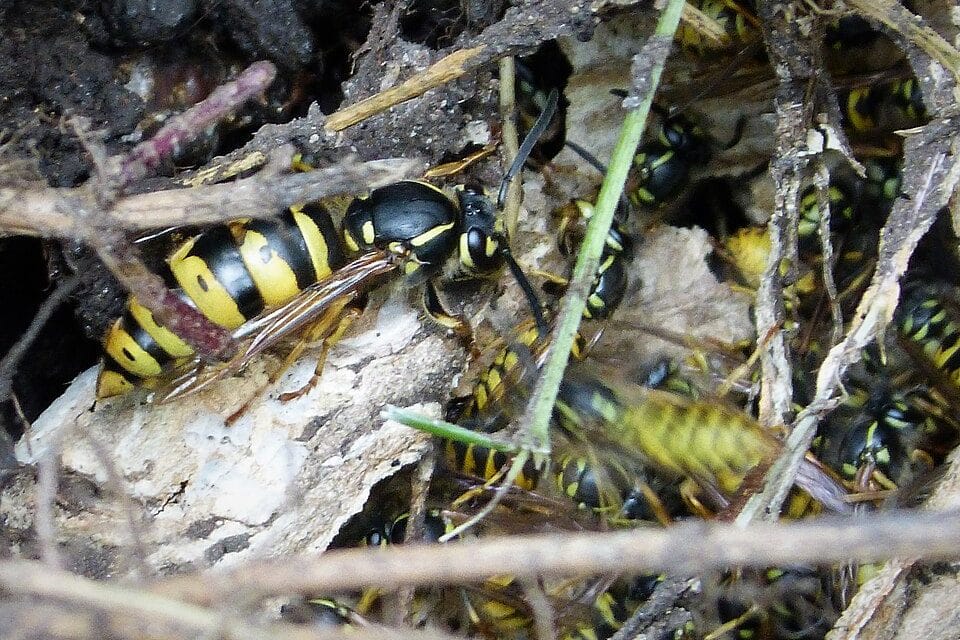
Walk round the back of most British houses in mid-July and you'll hear it before you see it — a low, papery hum coming from somewhere under the eaves, inside a wall cavity, or tucked into a garden shed roof. By this point in the season a wasp nest that started as a golf-ball-sized cluster in May has usually grown into something the size of a football, or bigger, and the colony inside can number anywhere from 2,000 to 5,000 workers. Whether you deal with it yourself or hand it to a professional depends less on how brave you're feeling and more on three things: where the nest is, how big it already is, and whether anyone in the house reacts badly to stings.
Why July is the tipping point
Common wasps (Vespula vulgaris and Vespula germanica) build a paper nest from chewed wood pulp, starting with a single queen in spring. Through May and June the colony is small and the workers are mostly busy — they're out foraging for insects to feed the larvae, not defending territory. That changes around late July into August, when the colony hits its peak population and switches from raising larvae to producing new queens and males. Workers become noticeably more aggressive at this stage because there's less brood to protect and more sugar-seeking behaviour, which is also why wasps suddenly seem obsessed with your barbecue, your pint glass and the bin. A nest you could have removed safely in June is a genuinely different proposition by the third week of July.
Size is the easiest way to judge urgency. A nest still under 15cm across, visible and accessible, with only a handful of wasps coming and going, is usually a small early-stage colony — this is the window where a DIY approach is realistic. Once it's the size of a rugby ball, hidden inside a cavity wall, roof void or chimney, or you can't get a clear, unobstructed view of the entry point without standing directly underneath it, the calculation changes. At that size a nest can hold thousands of wasps, and disturbing it without proper protection is how people end up with dozens of stings in under a minute.
When DIY is genuinely fine
If the nest is small, external, and reachable from the ground without a ladder, a wasp nest killer powder or foam puffed directly into the entrance at dusk — when the wasps are inside and sluggish — will usually finish the colony within 24 to 48 hours. B&Q and Wickes both stock Nippon or Doff wasp nest killer for around £6–£10, and Rentokil also sells a consumer-grade foam spray with a long-reach nozzle for roughly £12. Do it at dusk or after dark, not during the day: wasps return to the nest to sleep, and a night-time treatment means you're dosing the whole colony at once rather than the handful that happen to be home.
Wear long sleeves, trousers tucked into socks, and have an exit route planned before you start — walk backwards away from the nest immediately after treating it, don't linger to check your work. Leave the nest alone for at least 24 hours before going anywhere near it again; wasps can survive the initial dose for a short while and will still sting if disturbed. Don't block the entrance immediately after treating — sealing it too soon traps live wasps inside, and they'll often chew a new exit hole somewhere less convenient, sometimes straight through plasterboard into a bedroom.
What not to do
- Don't throw water at a nest, ever — it doesn't drown them, it agitates the whole colony at once
- Don't use a vacuum cleaner on an active nest unless it's a proper pest-control model with a sealed chamber
- Don't burn or set fire to a nest under eaves or in a roof void — this is a genuine fire-starting risk that insurers take seriously
- Don't stand directly below the entrance while treating it, even at night
When to call a professional
Book a professional the moment any of these apply: the nest is inside a cavity wall, loft, or chimney where you can't see how big it's grown; it's more than about 2 metres up and needs a ladder; anyone in the household has had a serious reaction to a wasp sting before, including swelling that spread beyond the sting site; or there are young children, elderly relatives, or pets who use that part of the garden regularly. A local pest controller registered with the British Pest Control Association typically charges £60–£100 for a same-week wasp nest treatment, rising to £120–£150 for hard-to-reach nests in a roof space or an occupied cavity wall. Rentokil's national call-out for a single external nest usually sits around £90–£120 including VAT, though pricing varies by region and how urgently you need it done — same-day slots cost more than a booking three days out.
It's worth checking BPCA membership before booking anyone who turns up on your doorstep after a cold call — reputable local firms are almost always registered, and membership means they're insured and trained in the correct chemicals. A nest inside a chimney breast is one case where I'd never recommend the DIY route, regardless of size: chimneys funnel treated wasps and dust straight back into the house, and if the flue is still in occasional use there's a genuine risk of setting off treatment residue when you next light a fire.
If someone gets stung
A single sting causes localised pain, swelling and redness that usually settles within a few hours — an antihistamine like cetirizine and a cold compress deal with most cases. Multiple stings (more than around ten to twenty, depending on body size) can cause a more serious reaction even in people who aren't allergic, because of the cumulative dose of venom, and NHS guidance is to seek medical help if someone has been stung many times or stung in the mouth or throat. Anaphylaxis is different and needs 999 immediately: difficulty breathing, swelling of the face, lips or throat, a fast heartbeat, dizziness, or a rash spreading rapidly over the body away from the sting site. If anyone in the family has an EpiPen for a known wasp allergy, this is exactly the season to check it hasn't expired — auto-injectors typically have a shelf life of 12–18 months and it's easy to lose track over winter.
Prevention for the rest of the season
Nests don't reuse the same spot next year — a treated or removed nest won't come back in the same place — but a garden that had one nest this July often has the conditions for another. Check soffits, roof tile gaps, shed eaves and any air brick with damaged mesh in early spring next year, since that's when queens are scouting for a new site and a small nest at that stage is trivial to deal with. For the rest of this summer, keep bins with tight-fitting lids, rinse recycling before it goes out, and if you're eating outdoors, cover sweet drinks — an unattended glass of squash or cider is one of the most common ways people get stung, because the wasp is inside the glass by the time anyone notices.
None of this means treating every wasp near the patio as an emergency. Most of what you'll see in a British garden in July is foraging activity that has nothing to do with a nest on your own property — it could easily belong to a neighbour three doors down. The nest itself, once you've actually located it, is what determines whether this is a Saturday-afternoon job with a can of Doff foam or a phone call to someone properly trained to do it for you.